Pretty much every senor signal in your car will be either a digital or analog signal. There are some exceptions such as flex fuel sensors, some newer wheel speed sensors, PULS oil sensors, or SENT sensors that can use a combination of analog voltage and or digital signals.
Analog
Analog signals are variable voltage typically anywhere from 0v to 5v produced by a "volage divider" circuit. Some examples of analog signals are temperature and pressure signals or rotary knobs.
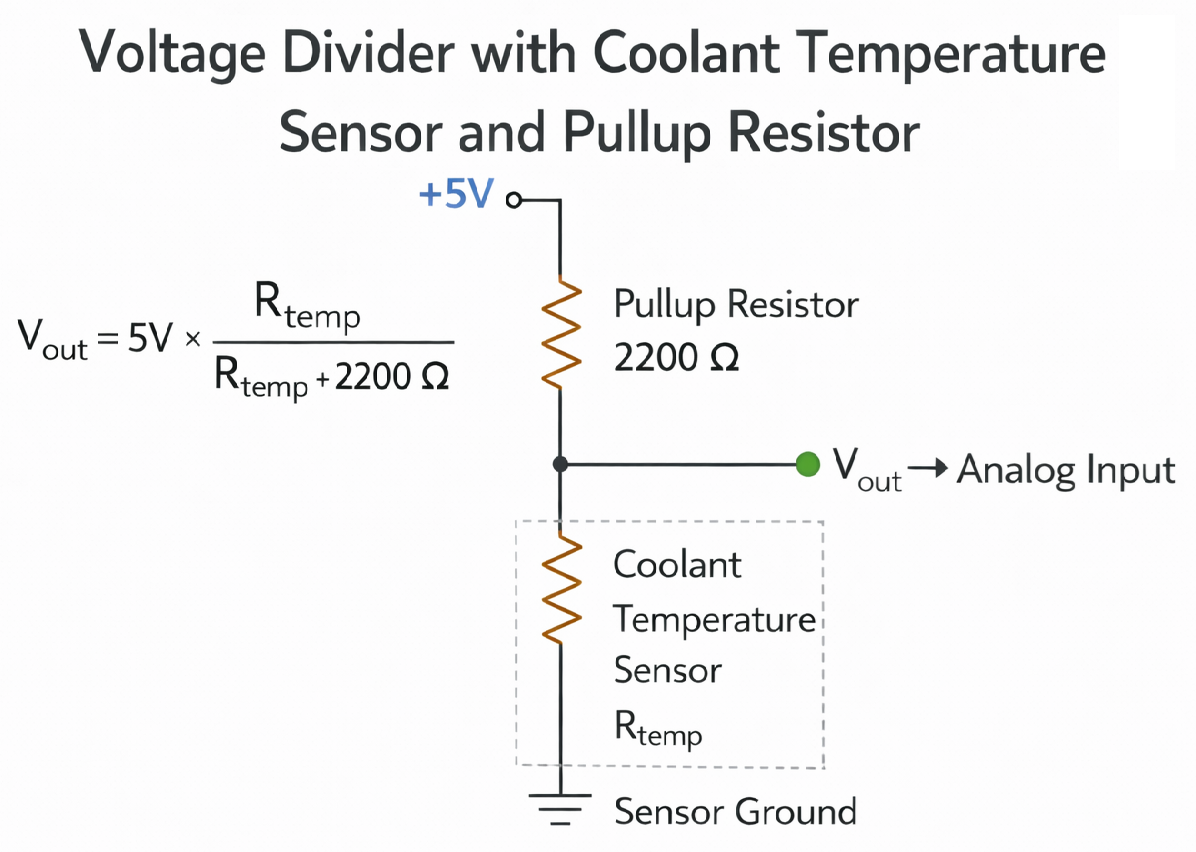
Most temperature sensors have 2 pins and require an additional resistor to complete the voltage divider circuit. One pin will be wired to a sensor ground, and the other pin is the signal wired to an analog input. The resistor needs to be wired in between a 5v source and the signal wire. Many of our EMU's have these built in internally and can be enabled in the software.
Typical pressure sensors will have 3 pins. Sensor ground, 5V reference, and pressure signal. These have an internal circuit and do not require the external resistor.
Rotary knobs or rotary switches often use a similar circuit as the temperature sensor, with different resistance at each knob position to create distinct voltages.
Often buttons or switches are also wired to analog inputs. However, they typically only have an ON or OFF state and can therefore be considered a digital signal. They can be wired to either analog or digital inputs. Switches will need a pullup or pulldown resistor for resetting the state when the switch is open.
Digital
There are a few main types of digital signal types. Variable reluctance (VR) or Hall Effect. These sensors measure teeth on a rotating wheel. The signal voltage may change, but they are read by the ECU as high or low. Examples of digital signals are crankshaft position, camshaft position, and wheel speed.
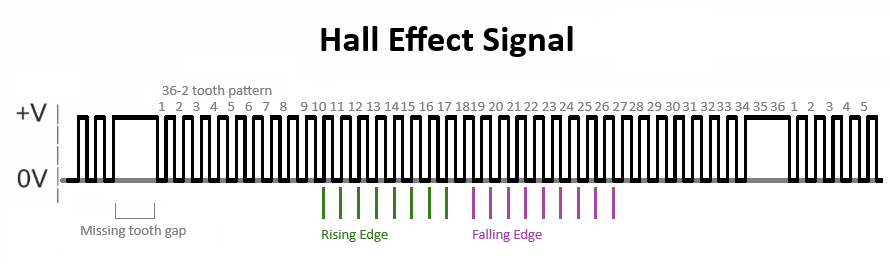
Hall effect sensors are fairly simple to understand as they will produce a "square wave" signal. For example the signal will switch between 2 states, 5v when it is "high" and 0v when it is "low".
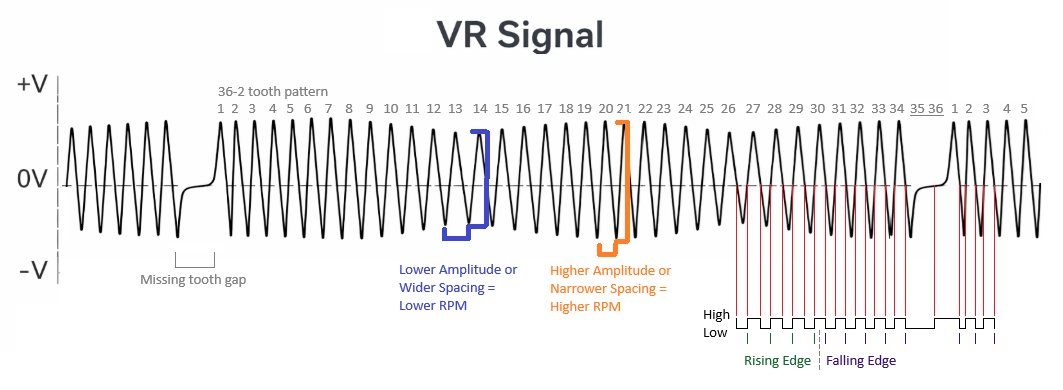
VR sensor signals are a bit more complicated to read because they don't produce a clean square wave and the signal voltage changes based on speed and other factors. They are "high" when the voltage is above 0v and "low" when the voltage is below 0v. The edge is also more critical. In missing tooth gaps you need to select the correct edge to get a valid signal. In the example above, falling edge must be selected, otherwise there will be two medium length gaps instead of one long gap.
Was this article helpful?
That’s Great!
Thank you for your feedback
Sorry! We couldn't be helpful
Thank you for your feedback
Feedback sent
We appreciate your effort and will try to fix the article