Some alternators have been controlled with an H-Bridge output during development. This is achieved by sending a 12v pulsed signal to the correct alternator terminal. (There are many Alternator types. Research your specific alternator for which terminal a 12v PWM signal should be applied.)
Caution: If the alternator is not working correctly after it has been wired to the EMU, "STOP", shut off the power, disconnect the battery terminal, and look carefully at your charging system wire diagram to verify you have connected correctly. If you do not know how an alternator functions, have an engine electronic technician wire this and configure for you.
If the "Alternator" control feature is not working well in your specific alternator, then the Parametric output may be a solution.
A [Parametric output] is simple. It is a reliable way we have controlled alternator voltage output on development vehicles that need ECU Alternator control.
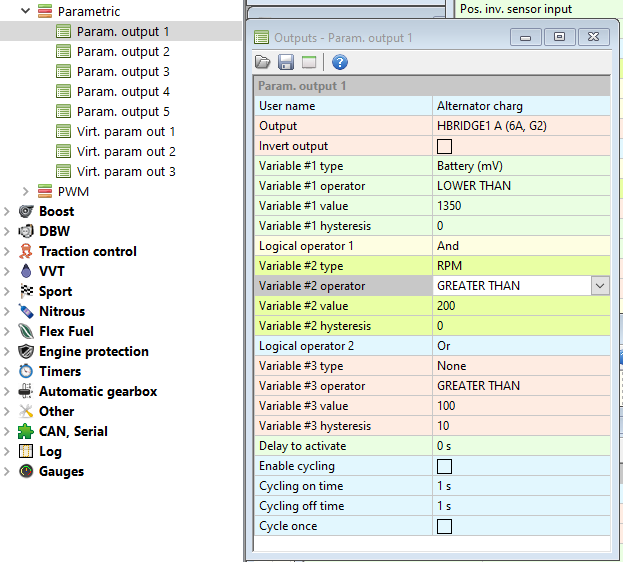
The Parametric output will give a 12v pulse when the voltage falls under 1350mv (13.5 volts) then turns off once it reaches 1350mv, etc...
Assign an H-Bridge output to any of the Parametric outputs then set the logical operations the same as the screenshot below then verify.
The EMU, charging system, vehicle electrical components, and alternator can be damaged if installed and configured incorrectly.
Was this article helpful?
That’s Great!
Thank you for your feedback
Sorry! We couldn't be helpful
Thank you for your feedback
Feedback sent
We appreciate your effort and will try to fix the article